
CO₂-rock interaction changes the failure mode of clay-rich sandstone
Understanding whether reservoir rocks fail in a brittle or ductile manner is essential for evaluating formation integrity during geological carbon storage. We investigated how prolonged CO₂-rock interaction affects the failure behavior of clay-rich Tuscaloosa sandstone [1]. Fully saturated sandstone specimens were exposed to 10 MPa CO₂ at 85 °C for 12 weeks and subsequently tested under triaxial compression at a confining pressure of 5 MPa. Acoustic emission monitoring was used to characterize the associated microcracking processes.
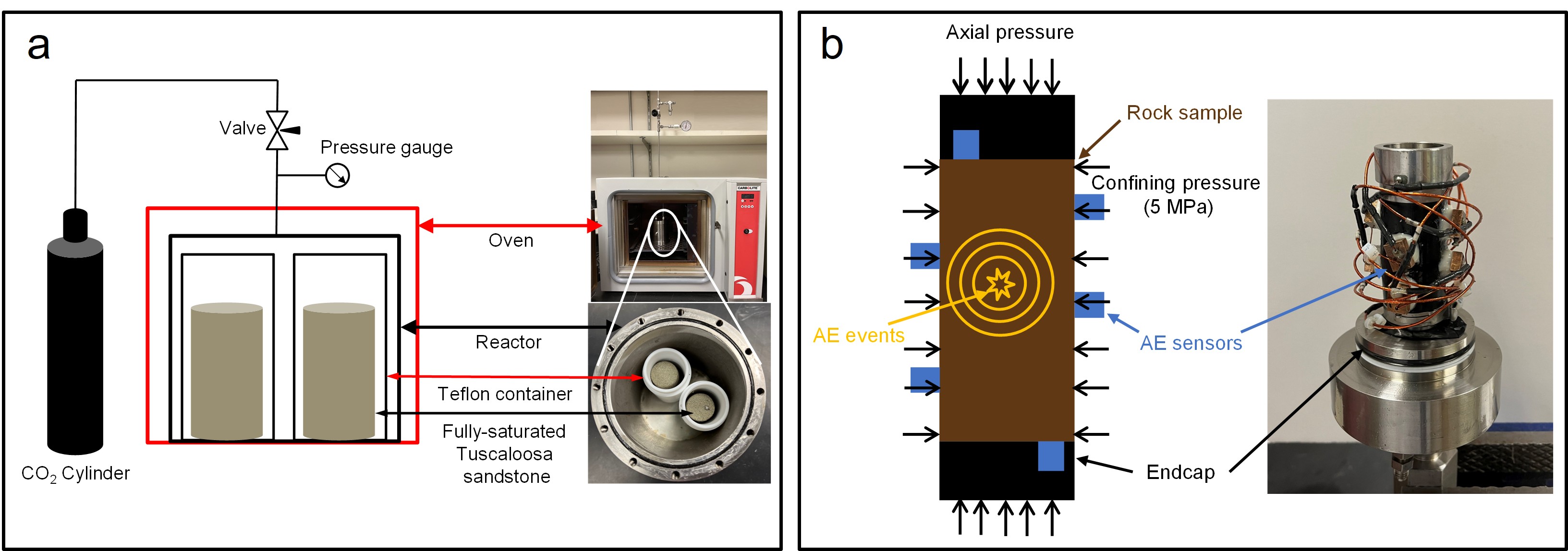
Experimental setup for the CO₂ treatment test (left) and the triaxial compression test with acoustic emission monitoring (right).
Microscopic observations reveal that CO₂-rock interaction caused the dissolution of pore-lining and pore-filling clay minerals and the precipitation of new crystals within the pore space. In particular, the degradation of soft chlorite coatings around quartz grains reduced their lubricating effect. This reaction-induced microstructural alteration facilitates direct interactions, sliding, microcracking, and fragmentation among stiff quartz grains and newly precipitated crystals.
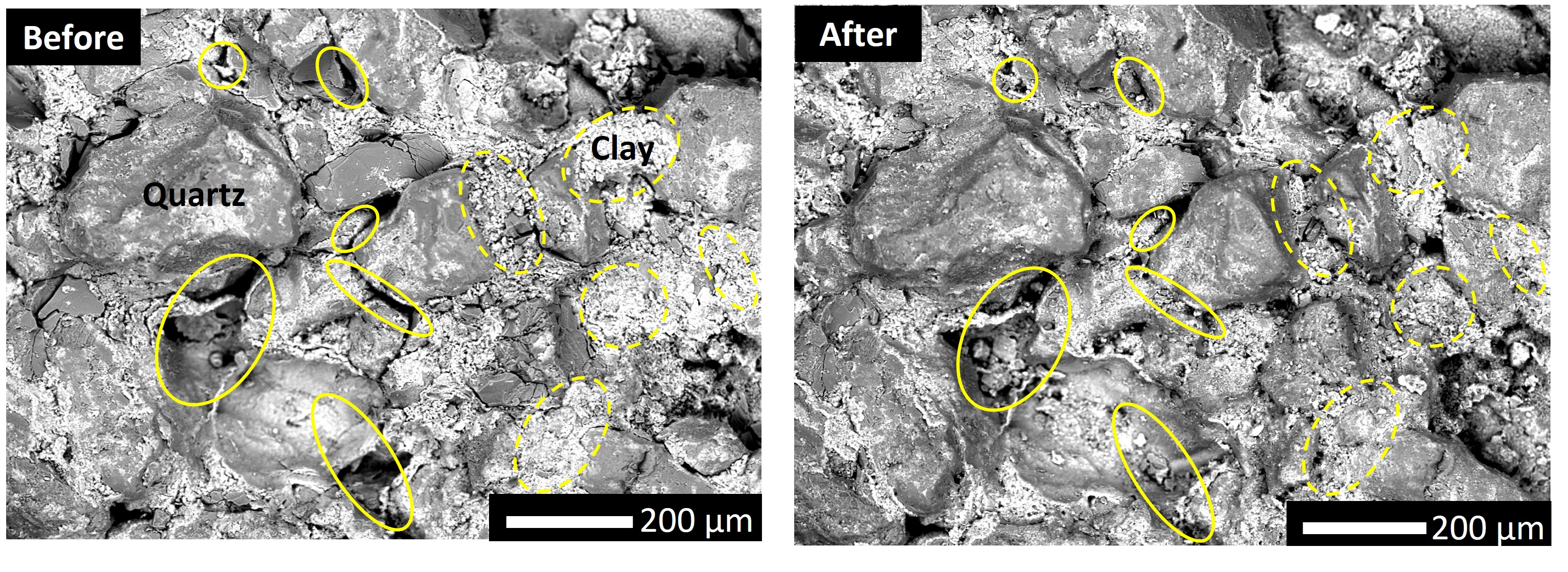
SEM images of Tuscaloosa sandstone before and after CO₂ exposure, showing clay dissolution (dashed ellipses) and newly precipitated crystals (solid ellipses).
Triaxial compression tests demonstrated that Tuscaloosa sandstone containing approximately 28% clay transitioned from semi-brittle to brittle failure after CO₂ treatment. The treated specimens exhibited a sharper post-peak stress drop, substantially higher acoustic emission activity during unstable crack propagation, and brittleness indices up to 2.69 times those of the control specimens. These results demonstrate that fluid-induced chemical reactions—not only physical factors such as pressure and temperature—can control the failure mode of reservoir rocks.
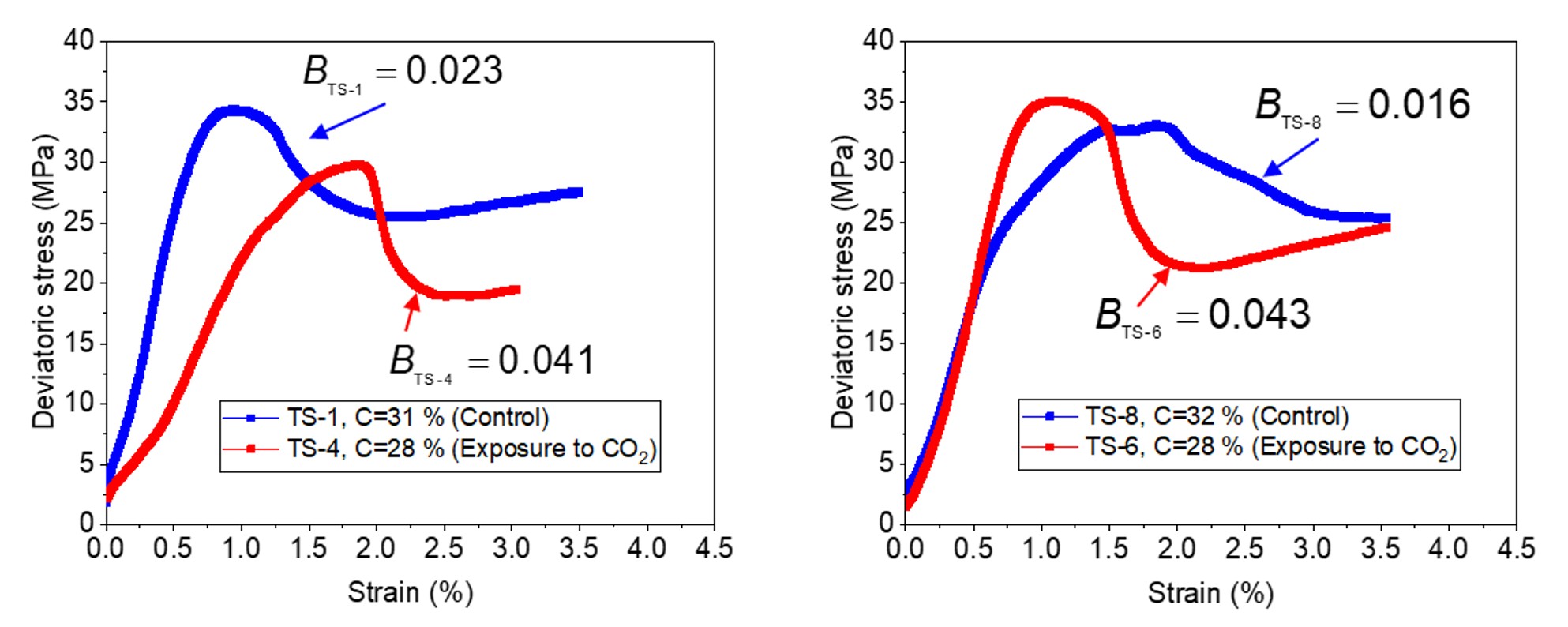
Stress-strain responses showing the transition from semi-brittle behavior in the control specimens to more brittle failure after CO₂ exposure.
The transition, however, depends strongly on the initial clay content and permeability of the sandstone. Specimens with higher clay contents of 38–44% and relatively low permeability remained semi-brittle after CO₂ exposure, suggesting that limited reaction and transport were insufficient to produce a failure-mode transition. These findings highlight the importance of considering mineralogy, permeability, and reaction-induced mechanical changes when assessing the long-term integrity of geological CO₂ storage formations.
Reference:
[1] Guo T.Y., & Vanorio T. (2026). The effects of CO₂-rock interaction on the failure mode of clay-rich sandstone. International Journal of Greenhouse Gas Control, 155, 104757. https://doi.org/10.1016/j.ijggc.2026.104757